Noisy open space: a comprehensive strategy for improving office acoustics | .mdd
[ ](https://mdd.eu/en/) - [ Products ](/en/products/) Products
Categories
[ New products ](/en/new-products/)
[ Outdoor ](/en/outdoor/) Outdoor
[ All ](/en/outdoor/) [Outdoor seating](/en/outdoor/seating/) [Outdoor tables](/en/outdoor/tables/) [Accessories for outdoor furniture](/en/outdoor/accessories-for-outdoor-furniture/)
[ Seating ](/en/seating/) Seating
[ All ](/en/seating/) [Office chairs](/en/seating/office-chairs/) [Meeting chairs](/en/seating/meeting-chairs/) [High stools](/en/seating/high-stools/) [Kitchen and dining chairs](/en/seating/kitchen-chairs/) [Stackable chairs](/en/seating/stackable-chairs/) [Sofas](/en/seating/sofas/) [Armchairs](/en/seating/armchairs/) [Poufs](/en/seating/poufs/) [Lounge](/en/seating/lounge/) [Benches](/en/seating/benches/) [Footrests](/en/seating/footrests/) [Wooden seats](/en/seating/wooden-seats/) [Plastic chairs](/en/seating/plastic-chairs/) [Accessories for seating](/en/seating/accessories-for-seating/)
[ Receptions ](/en/receptions/) Receptions
[ All ](/en/receptions/) [Reception desks](/en/receptions/reception-desks/) [Accessories for reception desks](/en/receptions/accessories-for-reception-desks/)
[ Desks ](/en/desks/) Desks
[ All ](/en/desks/) [Height adjustable Desks](/en/desks/height-adjustable-desks/) [One-station desks](/en/desks/one-station-desks/) [Bench desks](/en/desks/bench-desks/) [Desks with storage](/en/desks/desks-with-storage/) [Desk systems](/en/desks/desk-systems/) [Executive desk](/en/desks/executive-desk/) [Accessories for desks](/en/desks/accessories-for-desks/)
[ Storage furniture ](/en/cabinets-and-pedestals/) Storage furniture
[ All ](/en/cabinets-and-pedestals/) [Pedestals](/en/cabinets-and-pedestals/pedestals/) [Cabinets](/en/cabinets-and-pedestals/cabinets/) [Storage cabinets](/en/cabinets-and-pedestals/storage-cabinets/) [Bookcases](/en/cabinets-and-pedestals/bookcases/) [Wardrobes](/en/cabinets-and-pedestals/wardrobes/) [Glass-door cabinets](/en/cabinets-and-pedestals/glass-door-cabinets/) [Executive cabinets](/en/cabinets-and-pedestals/executive-cabinets/) [Coat racks](/en/cabinets-and-pedestals/coat-racks/) [Plant pots](/en/cabinets-and-pedestals/plant-pots/) [Accessories for storage](/en/cabinets-and-pedestals/accessories-for-storage/)
[ Acoustics ](/en/acoustics/) Acoustics
[ All ](/en/acoustics/) [Booths](/en/acoustics/acoustic-pods/) [Freestanding screens](/en/acoustics/freestanding-screens/) [Acoustic wall and ceiling panels](/en/acoustics/wall-panels/) [Desk screens](/en/acoustics/desk-panels/) [Meeting cubicles](/en/acoustics/meeting-cubicles/) [Accessories for acoustics](/en/acoustics/accessories-for-acoustics/)
[ Tables ](/en/tables/) Tables
[ All ](/en/tables/) [Dining tables](/en/tables/dining-tables/) [Coffee tables](/en/tables/coffee-tables/) [Café tables](/en/tables/cafe-tables/) [High tables](/en/tables/high-tables/) [Executive tables](/en/tables/executive-tables/) [Folding tables](/en/tables/folding-tables/) [Conference tables](/en/tables/conference-tables/) [Modular tables](/en/tables/extendable-tables/) [Multimedia station](/en/tables/multimedia-station/) [Side tables](/en/tables/side-tables/) [Accessories for tables](/en/tables/accessories-for-tables/)
[ Lamps ](/en/lamps/)
[ Tamo ](https://mdd.eu/en/tamo/) Tamo
[ All ](https://mdd.eu/en/tamo/) [ Seating ](https://mdd.eu/en/tamo/seating/) [ Wooden seats ](https://mdd.eu/en/tamo/wooden-seats/) [ Wooden desks ](https://mdd.eu/en/tamo/desks/) [ Wooden tables ](https://mdd.eu/en/tamo/tables-and-side-tables/) [ Storage ](https://mdd.eu/en/tamo/storage/) [ Lamps ](https://mdd.eu/en/tamo/lamps/) [ Accessories ](https://mdd.eu/en/tamo/accessories/)
[All furniture](/en/products/)
- [ Collections ](/en/collections/) Collections
Collections
[ All ](/en/collections/)
[ Seating ](/en/collections/seating/)
[ Desks ](/en/collections/desks/)
[ Executive Office ](/en/collections/executive-office/)
[ Outdoor ](/en/collections/outdoor/)
- [ CustomerProjects ](/en/realizations/)
- [ For Architects ](/en/programme-for-architects/) For Architects
For Architects
[ Image Bank ](/en/image-bank/)
[ Order Swatches ](/en/swatches-and-sample-sets/)
[ Digital Tools ](/en/digital-tools/)
- [ B2B ](/en/b2b/) B2B
B2B
[ Linx ](https://www.mddlinx.com/?jezyk=en)
[ B2B ](/en/b2b/)
[ Product Feed ](/en/product-feed/)
- [ About Us ](/en/about-us/) About Us
About Us
[ Designers ](/en/our-designers/)
[ Sustainability ](/en/sustainability/)
- [ Contact ](/en/contact/)
[ My account ](/en/customer/login/) [ Enquiries ](https://mdd.eu/en/productenquiry/index/index/) [ Offer ](https://mdd.eu/en/offers/)
![]()
$refs.search.focus())" @click.away="isSearchActive = false" class="lg:c-hidden c-flex c-h-full c-cursor-pointer c-items-center c-px-2" >
[ ](/en/customer/login/)
0 && changeCartOpenState($dispatch)" class="c-h-full c-px-2"> 1
#### Product Enquiry
Amount of products: 1
![]() ![]()
Paralel
Quantity:
i.id) : [item.id], item.quantity)">
i.id) : [item.id], item.quantity)"> i.id) : [item.id], item.quantity)">
deleteItemFromCart(item.productType === 'grouped' ? item.items.map(i => i.id) : [item.id]), message: 'Are you sure you want to remove this product from your enquiry?' })"> Delete
Inc VAT
Sum:
[ See the product enquiry](https://mdd.eu/en/productenquiry/index/index/)
0 && changeCartOpenState($dispatch)" class="c-h-full c-px-2">
#### Quotation
Amount of products:
![]()
[ Go to quotation ](https://mdd.eu/en/offers/)
0 && changeCartOpenState($dispatch)" class="c-h-full c-px-2">
#### Shopping cart
Amount of products: 1
![]()
Quantity:
deleteItemFromCart(index), message: 'Are you sure you want to remove this product from your cart?' })"> Delete
Sum:
[ Proceed to cart ](https://mdd.eu/en/app/cart/)
Select your region to check prices in your currency, VAT rate, and shipping costs.
Austria
Belgium
Bulgaria
Croatia
Czechia
Denmark
Estonia
Finland
France
Germany
Greece
Hungary
Italy
Ireland
Lithuania
Luxembourg
Latvia
Netherlands
Norway
Poland
Portugal
Romania
Slovakia
Slovenia
Spain
Sweden
Switzerland
United Kingdom
United States
Other regions
Czy napewno chcesz usunąć ten produkt z zapytania?
Cancel Delete
![]() ![]() deleteItemFromCart(index), message: 'Are you sure you want to remove this product from comparison?' })">
[View comparison
](/en/comparison)
[ View comparison
](/comparison) deleteAllItemsFromCart(), message: 'Are you sure you want to remove all products from comparison? ' })"> Clear all
[ ](https://mdd.eu/en/) › [News and Blog](https://mdd.eu/en/blog) › Noisy open space: a comprehensive strategy for imp...
News
Noisy open space: a comprehensive strategy for improving office acoustics
=========================================================================
Introduction and acoustic diagnosis of open space
2025.11.26 13m Views: 2773
- [ Definition of the acoustic problem in an open space model ](#blog-post-title-description-image-vertically-12665)
- [ The impact of prolonged exposure to noise on human capital ](#blog-post-title-description-image-vertically-12666)
- [ Acoustic metrics and initial audit ](#blog-post-title-with-description-12667)
- [ Basic measurements required in the office ](#blog-post-title-with-description-12668)
- [ Reverberation time control (RT60) – the key to clarity ](#blog-post-title-with-description-12669)
- [ Sound absorption coefficient (NRC and αw) ](#blog-post-title-with-description-12670)
- [ Design and organisational strategy (activity-based working – ABW) ](#blog-post-title-description-image-vertically-12671)
- [ Acoustic design from the conceptual level ](#blog-post-title-with-description-12672)
- [ Space zoning (activity-based working – ABW) ](#blog-post-title-with-description-12673)
- [ The role of behavioural rules and control of installation noise sources ](#blog-post-title-description-image-vertically-12674)
- [ Passive material solutions (absorption and insulation) ](#blog-post-title-with-description-12675)
- [ Vertical control: acoustic ceilings and ceiling absorbers ](#blog-post-title-with-description-12676)
- [ Horizontal control: walls, partitions and desk screens ](#blog-post-title-with-description-12677)
- [ Floor control and natural elements ](#blog-post-title-with-description-12678)
- [ Active acoustic management systems (sound masking) ](#blog-post-title-with-description-12679)
- [ Psychoacoustic principles of sound masking ](#blog-post-title-with-description-12680)
- [ Effectiveness and reduction of intelligibility range ](#blog-post-title-description-image-vertically-12681)
- [ Types of sound masking systems ](#blog-post-title-with-description-12682)
- [ Active masking vs. passive absorption ](#blog-post-title-with-description-12683)
- [ Implementation, costs and return on investment (ROI) ](#blog-post-title-with-description-12684)
- [ Acoustic audit and initial costs ](#blog-post-title-with-description-12685)
- [ Comparison of implementation costs ](#blog-post-title-with-description-12686)
- [ Calculating return on investment (ROI) in acoustics ](#blog-post-title-with-description-12687)
- [ Summary and implementation recommendations ](#blog-post-title-description-image-vertically-12688)
- [ Three pillars of effective acoustics ](#blog-post-title-with-description-12689)
- [ Office acoustics implementation checklist ](#blog-post-title-with-description-12690)
Definition of the acoustic problem in an open space model
---------------------------------------------------------
Open space office environments, although conducive to communication and collaboration, pose one of the greatest challenges to workplace ergonomics and acoustic environment management. According to Polish Standard PN-N-01307:1994, the permissible noise level for administrative offices should not exceed 55 dB, and for secretarial offices 65 dB. However, common measurements indicate that the average open-plan office regularly reaches a noise level of 70 dB, which is comparable to the noise generated on a busy street. Exceeding the standard by 15 dB places the working environment in the category of significantly disrupting concentration.
The main acoustic problems in an open-plan office stem from three factors. The first is the transmission of airborne and impact noise, especially in the context of poor sound insulation between individual office spaces, such as conference rooms. The second key factor is indoor reverberation, which, if uncontrolled, significantly contributes to noise accumulation and reduces speech intelligibility. The third factor is direct noise sources: constant background noise from conversations, ringing telephones, clicking keyboards, as well as noise generated by internal installations such as air conditioning systems (HVAC), printers and server rooms. A proper diagnosis requires measurement of all these sources of transmission and emission.
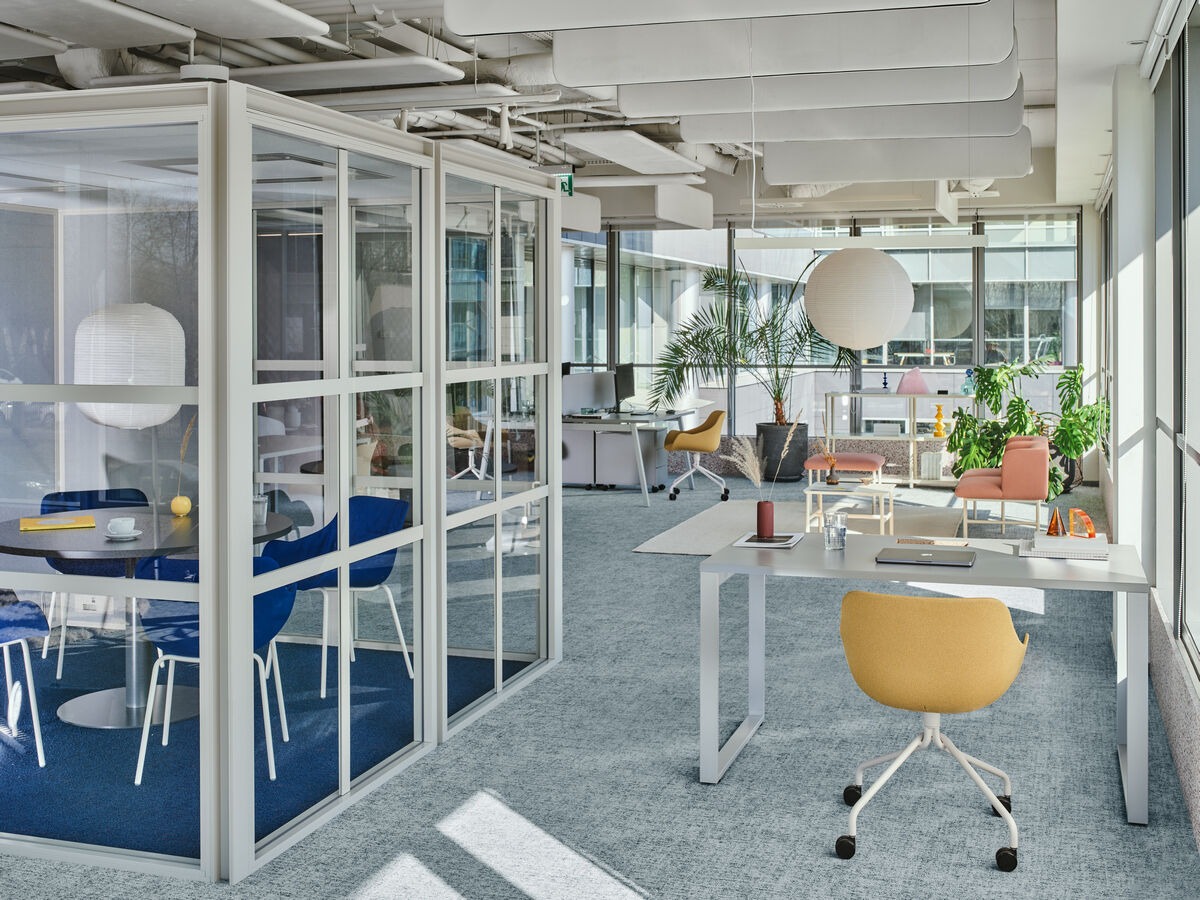 Open-plan office space with a grey acoustic booth for meetings
The impact of prolonged exposure to noise on human capital
----------------------------------------------------------
The consequences of exceeding permissible noise levels go beyond temporary discomfort. Prolonged exposure to excessive sound levels results in a significant decrease in operational efficiency and a negative impact on employee health. Studies show that employees can lose up to 86 minutes per day to unproductive activities caused by constant sound distraction. From an organisational perspective, this translates into measurable costs in terms of lost productivity, which is a key element in justifying the return on investment (ROI) in acoustics.
In terms of health, uncontrolled noise is one of the key ergonomic factors leading to chronic fatigue, irritation, reduced concentration, increased risk of errors, elevated levels of oxidative stress and, in the long term, burnout. Investing in noise reduction translates into real health benefits for the team, resulting in reduced absenteeism and lower treatment costs, which in turn improves the company's financial performance.
An effective noise reduction strategy must be treated not only as an improvement in comfort, but above all as a strategy for minimising operational and legal risks. Serious and prolonged exceedances of legally permissible noise levels (e.g. 70 dB instead of 55 dB) constitute a violation of occupational ergonomics standards. The requirement to create a high-quality acoustic environment and control noise is included in legal documents such as Directive 2002/49/EC and should be taken into account as early as the conceptual design stage.
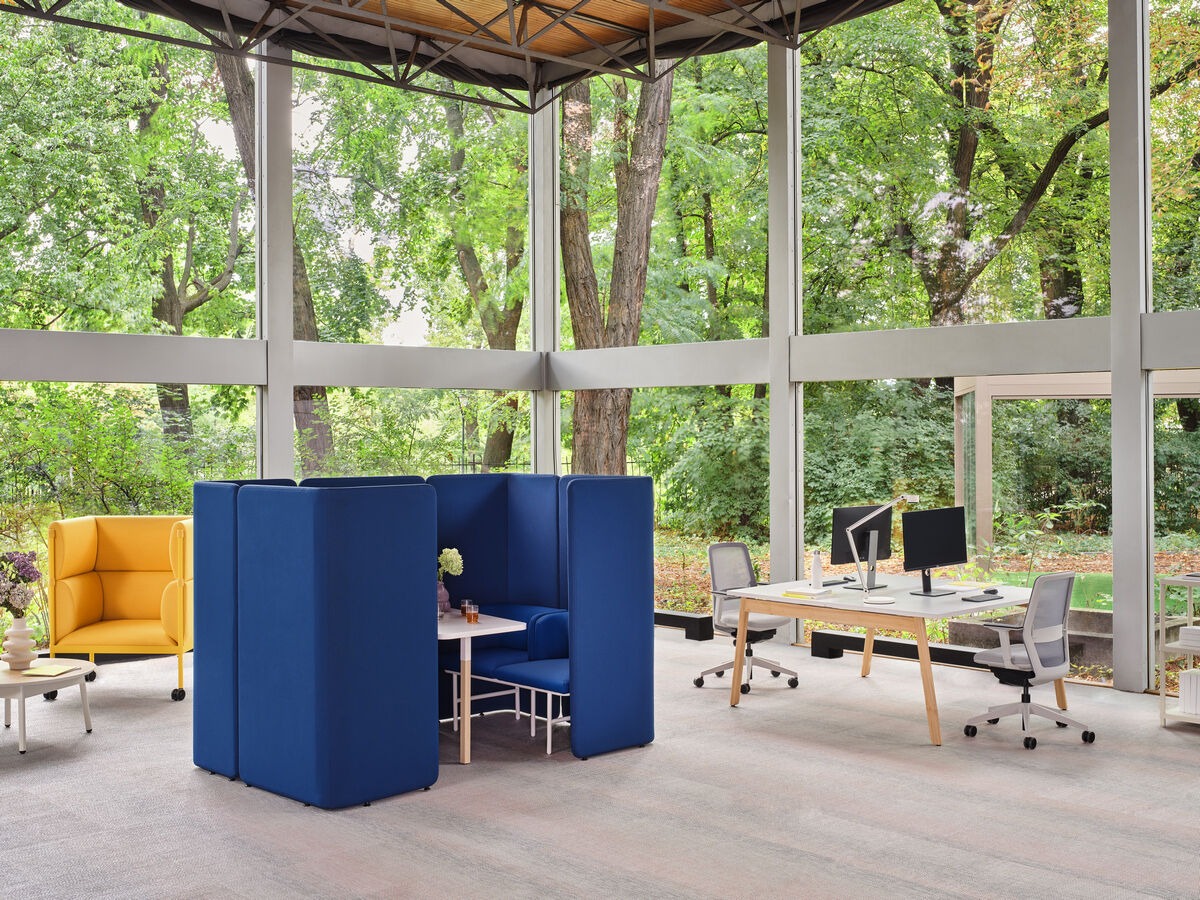 Open-plan office space with an upholstered navy blue meeting box
Acoustic metrics and initial audit
----------------------------------
Acoustic environment optimisation must be based on objective, measurable parameters. An initial acoustic audit is the first strategic step in identifying precise sources of noise and determining which solutions (absorption, insulation or masking) will be most effective.
Basic measurements required in the office
-----------------------------------------
Professional acoustic measurements and analyses should be performed by accredited laboratories with expertise in standard and specialist measurements. The scope of measurements includes:
- equivalent noise level (Leq): verification of compliance with the 55 dB standard;
- reverberation time (RT60): a key parameter for assessing the need for sound-absorbing materials;
- sound insulation of partitions: assessment of whether partitions between rooms (e.g. conference rooms) are sufficient to block airborne sound transmission;
- noise from installations: measurement of noise generated by internal equipment (HVAC, server rooms).
The costs of the initial audit and design represent a small part of the total expenditure, but are critical to the success of the project. The cost of the measurements alone ranges from PLN 3,500 to PLN 6,500 net, while a comprehensive acoustic design including detailed recommendations and simulations starts at PLN 15,000 to PLN 20,000 net.
Reverberation time control (RT60) – the key to clarity
------------------------------------------------------
Reverberation time (RT60) is a basic metric for assessing the acoustic quality of a room. It is the time it takes for the sound energy in a room to decrease by 60 dB after the sound source has ceased. In rooms with hard surfaces and large volumes, sound waves bounce off walls, floors and ceilings, accumulating and creating reverberation.
Long reverberation times lead to excessive echo, which results in poor speech intelligibility. In such conditions, quieter but crucial details (consonants) are masked by louder, longer-lasting sounds (vowels). A short RT60 time is essential for clearer and more intelligible sound. For offices and conference rooms, the target RT60 value should be 0.4 - 0.6 seconds. This value can be estimated at an early stage of design using Sabine's formula, which takes into account the volume of the room and the absorption coefficients of all surfaces.
Sound absorption coefficient (NRC and αw)
-----------------------------------------
Sound absorption can be determined using the Noise Reduction Coefficient (NRC) or the sound absorption coefficient αw\\alpha\_wαw.
Both indicators describe how effectively a given material absorbs sound energy instead of reflecting it.
The higher the NRC value (closer to 1.0), the better the material reduces reverberation and improves room acoustics.
For example, soft wall panels made of open-cell polyurethane foam can achieve an αw=0.80\\alpha\_w = 0.80αw=0.80 value, which indicates their high effectiveness in sound absorption.
For open spaces, however, it is crucial to understand the duality of acoustic objectives. On the one hand, it is necessary to achieve a low RT60 through the extensive use of absorbent materials. On the other hand, in a quiet environment, reducing background noise can paradoxically increase speech intelligibility (Speech Transmission Index, STI) over longer distances, which compromises the privacy of conversations. For this reason, optimal acoustic design for open spaces requires a combination of passive materials for reverberation control and active systems (sound masking) for STI control and speech privacy.
The table below summarises the key technical metrics required in an office environment:
Acoustic parameter Definition Polish Standard (PN) Target value (Open Space) Control Method Noise Level (Leq) Equivalent sound level PN-N-01307:1994
≤ 55 dB (administrative areas) Absorption, source control Reverberation Time (RT60) Time for sound energy to decrease by 60 dB ISO 3382
0.4 - 0.6 s Acoustic ceilings and panels (high NRC) NRC (αₓ) Average sound absorption ASTM C423
≥ 0.80 (for most surfaces) Selection of acoustic materials Speech intelligibility (STI) Speech transmission index IEC 60268-16
Low at a distance > 4 m Sound masking, insulation
Design and organisational strategy (activity-based working – ABW)
-----------------------------------------------------------------
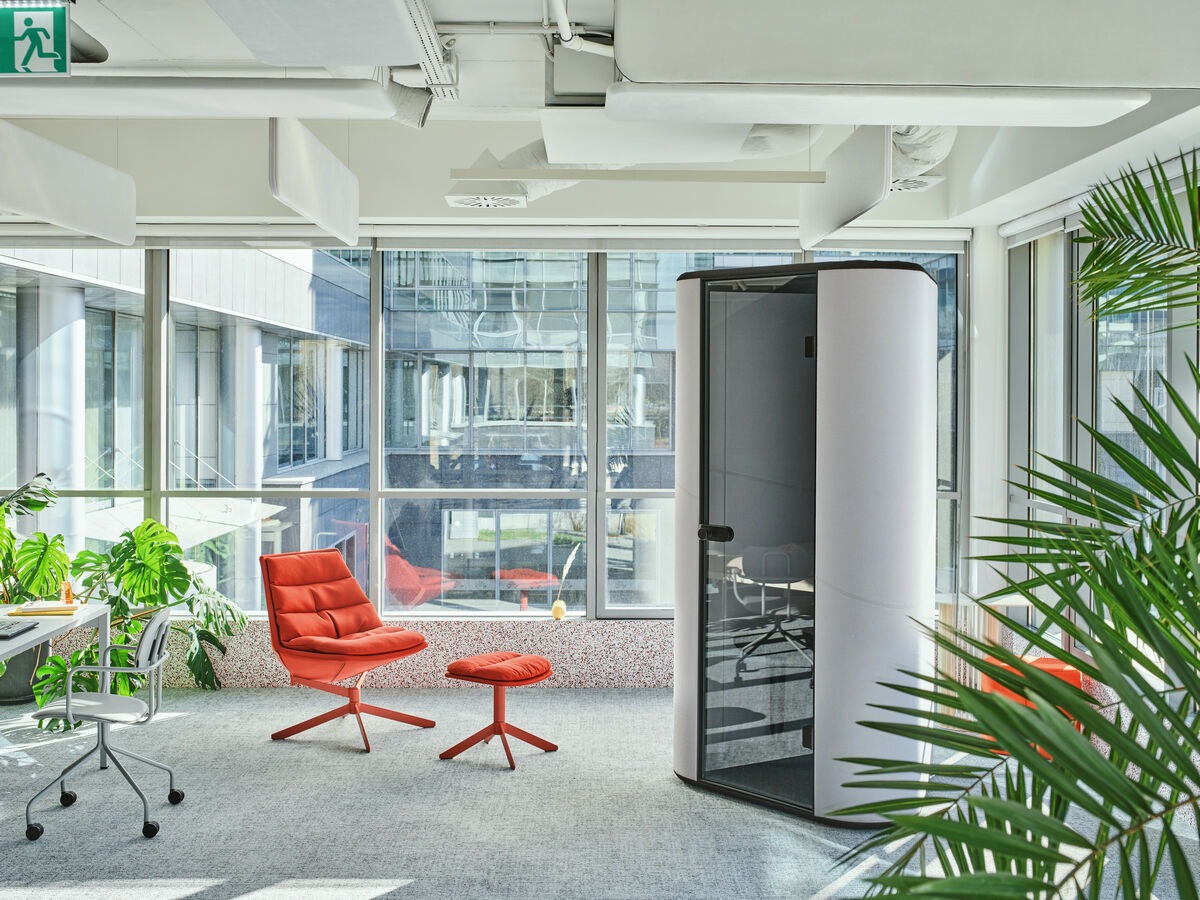 Office space with an acoustic booth and a red armchair
Acoustic design from the conceptual level
-----------------------------------------
Noise reduction is most effective when intervention occurs at the earliest possible stage of a project. Guidelines indicate that the main issues concerning the creation of a high-quality acoustic environment must be taken into account as early as the Conceptual Design (Level 1). Early risk assessment allows designers to implement the appropriate partition structure and select building materials, which prevents the need for costly adaptation and retrofitting work in later phases.
Space zoning (activity-based working – ABW)
-------------------------------------------
In open-plan offices, the best organisational solution for noise control is to implement the concept of Activity-Based Working (ABW). ABW involves flexible space management, giving employees the freedom to choose a workspace suited to a specific task, which directly minimises acoustic disturbances.
The implementation of ABW requires the creation of specialised zones with different acoustic requirements:
Quiet zones/focus rooms: These are designed for individual work and tasks requiring the highest level of concentration. They must have the lowest RT60 values and the highest sound insulation to ensure complete protection from outside noise.
Acoustic booths and cabins: Solutions such as hushMeet.L ensure privacy and isolate the sounds of telephone conversations or short meetings. They are key to isolating the most distracting source of sound — the human voice — from the main workspace.
Team space/communication zones: These areas are designed for collaboration and brainstorming. The acoustics should support communication, but at the same time, these zones must be buffered and equipped with strong absorbers so that sound does not carry into quiet zones.
Relaxation zones: Places where employees can recharge and take a break from ‘virtual (and physical) noise’.
The role of behavioural rules and control of installation noise sources
-----------------------------------------------------------------------
Physical zoning must be supported by clear behavioural rules and an organisational culture based on trust. Introducing rules requiring telephone calls to be made exclusively in acoustic booths or communication zones is crucial for maintaining silence in Focus zones.
In addition, strategic acoustic management requires consideration of the noise generated by infrastructure. Internal installations (air conditioning, server rooms) can cause significant disturbance. Therefore, before using panels and absorbers to control speech reverberation, it is necessary to physically separate or acoustically enclose these noisy installations. The design of an ABW facility must therefore include a detailed map of machine noise emissions and their minimisation through insulation to ensure that Focus Rooms are protected from impact and airborne sound transmission through partitions.
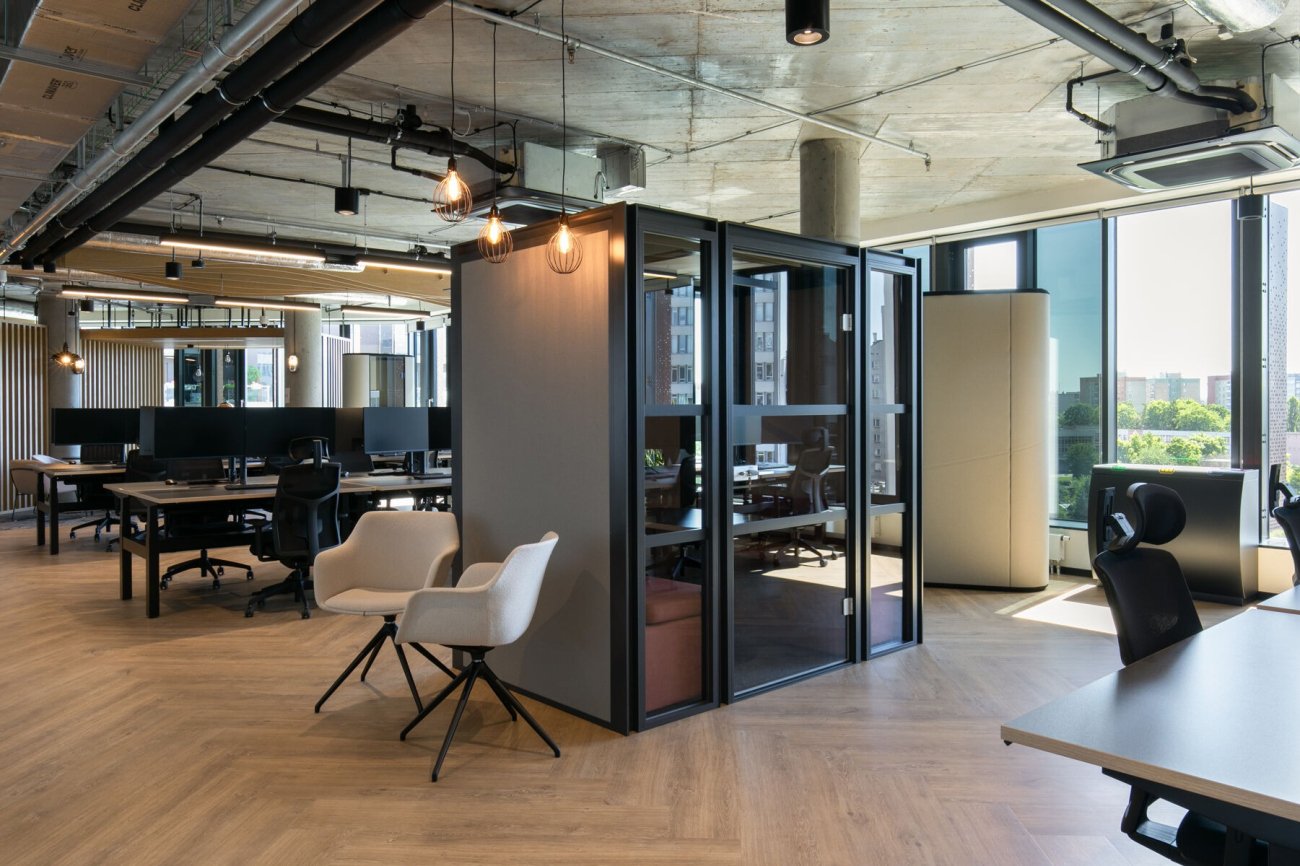 Open-plan office space with an industrial acoustic booth
Passive material solutions (absorption and insulation)
------------------------------------------------------
Passive solutions form the foundation of any successful acoustic strategy, focusing on controlling reverberation and blocking direct sound transmission.
Vertical control: acoustic ceilings and ceiling absorbers
---------------------------------------------------------
The ceiling is the largest surface in a typical office space and plays a dominant role in controlling RT60. Hard ceilings reflect sound waves, increasing reverberation, which increases the overall noise level.
Suspended ceilings: The use of ceilings with high absorption properties, made of materials such as mineral wool or special metals (e.g. Armstrong ceilings), can significantly reduce noise levels by reducing reverberation. When selecting ceiling tiles, always verify their acoustic parameters, in particular the NRC coefficient. Reverberation reduction is critical, especially in conference rooms.
Free-hanging absorbers: Suspended acoustic curtains, ceiling panels (e.g. Selva Sky) or ceiling baffles are extremely effective at absorbing sound, as they often have two active absorption surfaces. Their advantage is that they do not require any interference with the floor or wall layout.
Horizontal control: walls, partitions and desk screens
------------------------------------------------------
Sound absorption should be distributed across different planes to maximise control over sound waves.
Wall panels: Upholstered or foam wall panels (e.g. Silent Block, Fluffo Soft) absorb part of the sound wave. Their use is essential where hard, reflective surfaces predominate. Irregularly shaped panels also act as diffusers, scattering the remaining sound energy. These panels can also act as sound insulators if they are thick enough and cover the entire wall, helping to block the transmission of conversations from neighbouring rooms.
Desk-mounted and freestanding acoustic screens: Soft, upholstered panels attached directly to desks (e.g. Selva Desk) are designed to isolate a single workstation. They are most effective when placed close to the sound source, making them ideal for isolating the voice of an employee talking on the telephone. In high-intensity conversation environments, such as call centres, it is recommended to use tall, free-standing screens that surround the employee on three sides to provide complete protection from excessive noise.
Particular attention should be paid to the technical transparency of suppliers.
Although many manufacturers claim that their solutions are ‘highly effective in reducing noise’, the actual value of the investment depends on verified technical data.
Before purchasing, it is worth verifying certificates specifying sound absorption parameters, such as NRC or αw\\alpha\_wαw.
The lack of this information may result in the selection of products with low acoustic efficiency.
Professional technical specifications should always be based on documented parameters (e.g. αw=0.80\\alpha\_w = 0.80αw=0.80) rather than general marketing slogans.
Floor control and natural elements
----------------------------------
The floor, although often overlooked, is an important element of absorption. Sound-absorbing floor coverings play a key role in reducing impact noise, minimising the sound of footsteps or furniture being moved, which is essential for controlling the transmission of impact sound. In addition, green walls are a modern solution which, apart from their aesthetic function and improvement of air quality, naturally dampen noise, acting as a sound-absorbing element.
Active acoustic management systems (sound masking)
--------------------------------------------------
After implementing passive solutions to reduce RT60, a key step in creating a noise-free environment is to implement active systems that protect speech privacy and prevent distraction.
Psychoacoustic principles of sound masking
------------------------------------------
Sound masking is an advanced technology based on psychoacoustics. The system involves emitting specially created, discreet background sounds at low volume levels. This sound, often described as similar to the hum of airflow, is precisely tuned to the frequency spectrum of human speech.
The purpose of sound masking is not to physically muffle speech. Instead, the system raises the level of background noise, which exploits a perceptual phenomenon. The added background noise makes speech heard from a distance less intelligible and, as a result, less distracting to those around.
Effectiveness and reduction of intelligibility range
----------------------------------------------------
The effectiveness of a sound masking system is measured by the radical reduction in the range within which speech is intelligible and constitutes a disturbance. Typically, a masking system reduces this area from over 8 metres to around 4-5 metres. Achieving this effect requires two technical conditions to be met:
Appropriate frequency spectrum: Masking sounds must have the appropriate frequency characteristics and volume level to effectively affect speech intelligibility.
Homogeneity of sound reinforcement: A large number of sources (emitters/loudspeakers) are required, which must be evenly distributed throughout the space, often in a sound-absorbing suspended ceiling, to provide a uniform ‘sound cushion’ at all workstations.
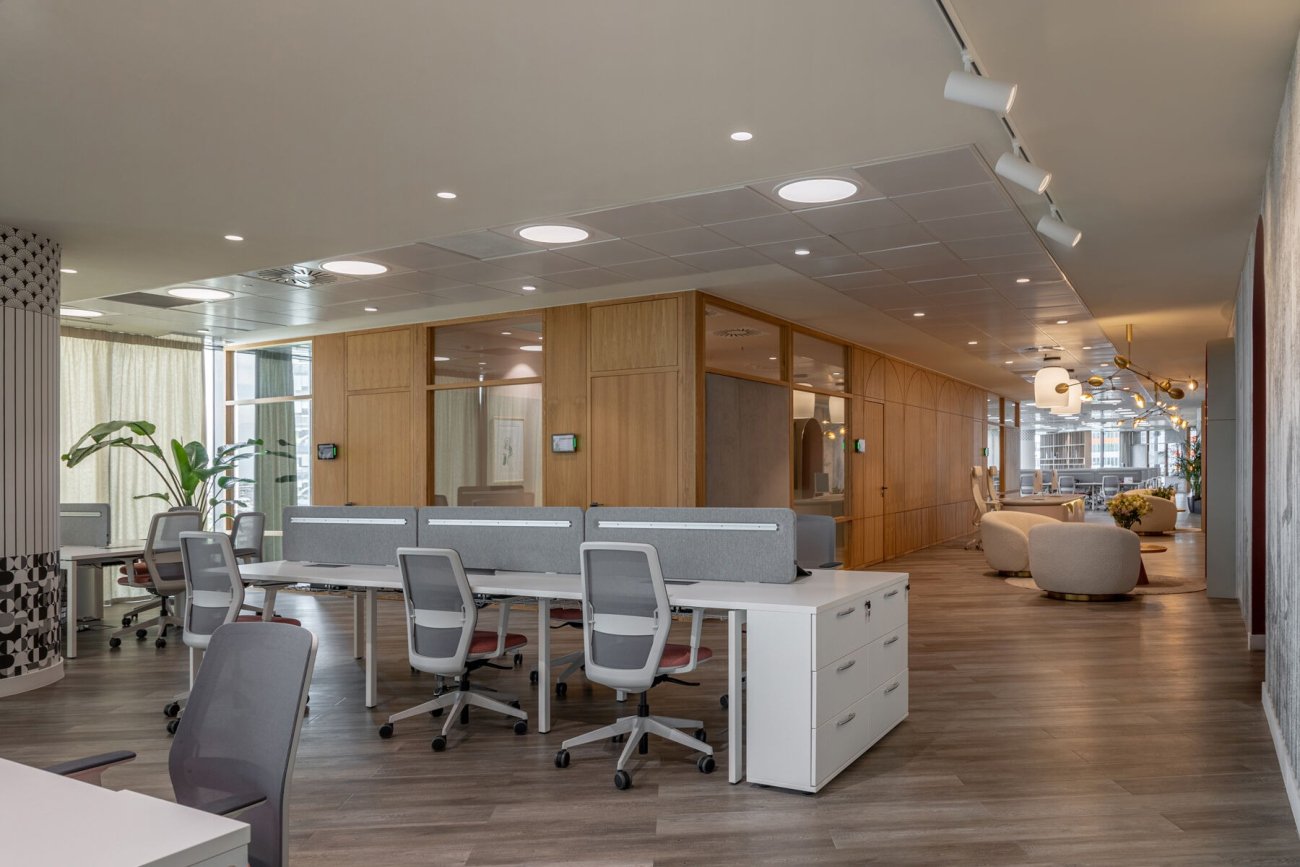 Open-plan office with desks equipped with acoustic panels
Types of sound masking systems
------------------------------
Sound masking systems differ in their installation methods:
- direct-Field systems: Systems such as QtPRO install small loudspeakers (emitters) directly into the suspended ceiling plane, directing sound downwards. This is the industry's first technology to deliver excellent uniformity and energy efficiency;
- plenum systems (indirect/concealed): Speakers are mounted in the plenum space (the void above the suspended ceiling panels). The sound is diffused and returns to the room through the panels. Although these systems are more visually discreet, they often require precise tuning to ensure uniformity. The DynasoundPRO system is an example of a solution that allows remote, individual control of each loudspeaker.
Active masking vs. passive absorption
-------------------------------------
The key difference is function: acoustic panels passively control sound behaviour in a room (reducing echo and RT60), while sound masking actively changes the acoustic environment by adding a controlled element. Passive (absorption) solutions address the issue of reverberation, while active (masking) solutions address the issue of speech intelligibility and privacy. An optimal office environment typically requires a synergy of both technologies.
Implementation, costs and return on investment (ROI)
----------------------------------------------------
Investment in acoustics must be considered from the perspective of a long-term cost-benefit analysis, where the return on investment (ROI) is calculated mainly on the basis of recovered productivity and improved employee health.
Acoustic audit and initial costs
--------------------------------
The investment should begin with professional consultation and an acoustic audit. As stated, achieving acoustic comfort through proper design costs less than subsequent, mandatory correction of acoustic defects. The initial cost of an acoustic design (from PLN 15,000) is strategically justified as insurance against costly redesign or losses resulting from inefficient operation.
Comparison of implementation costs
----------------------------------
The costs of individual technologies vary in nature, which determines the implementation phasing strategy:
- passive solutions (panels, ceilings): These are characterised by a lower cost per room and are easier to scale over time. They can be phased, starting with the areas with the highest acoustic priority. For example, wall panels can cost from PLN 25.94 to PLN 1,021.06 per unit;
- active solutions (sound masking): These require a higher upfront cost because the installation is centralised and must provide even coverage over a large open area. However, for large open spaces, sound masking is the most effective and cost-effective solution in the long term.
Calculating return on investment (ROI) in acoustics
---------------------------------------------------
The return on investment in acoustic improvements is easy to quantify at the operational and health levels:
Health ROI: Noise reduction translates into reduced exposure of employees to chronic ailments and stress, which lowers absenteeism rates and medical costs. A healthy employee is more productive and satisfied.
Productivity ROI: The main return comes from recovering time lost to distractions. Recovering even a fraction of the 86 minutes lost per employee per day quickly covers the cost of investing in acoustic systems.
To maximise budget efficiency, the investment must be sequential. Proper implementation first requires the use of large-scale passive absorption materials (ceilings, panels) to achieve the target low reverberation time (RT60 \\( 0.4-0.6 \\) s). Then, on this prepared acoustic foundation, an active sound masking system should be implemented to optimise STI. The effectiveness of sound masking is directly dependent on low reverberation in the room; without sufficient absorption, the masking noise can become another irritating source of noise.
Strategy Main acoustic objective Cost characteristics Key function in open spaces Direct source of ROI Passive absorption (ceilings, panels) Reverberation control (RT60) Lower, scalable Improved speech clarity at close range Reduced fatigue and irritation Isolation (screens, booths) Blocking sound transmission Medium, modular Physical separation of Focus and Calls zones Ensuring continuity of work on tasks Sound masking Reduced speech intelligibility (STI) Higher, centralised Privacy protection and distraction reduction Recovery of lost working time (e.g. 86 minutes/day)
Summary and implementation recommendations
------------------------------------------
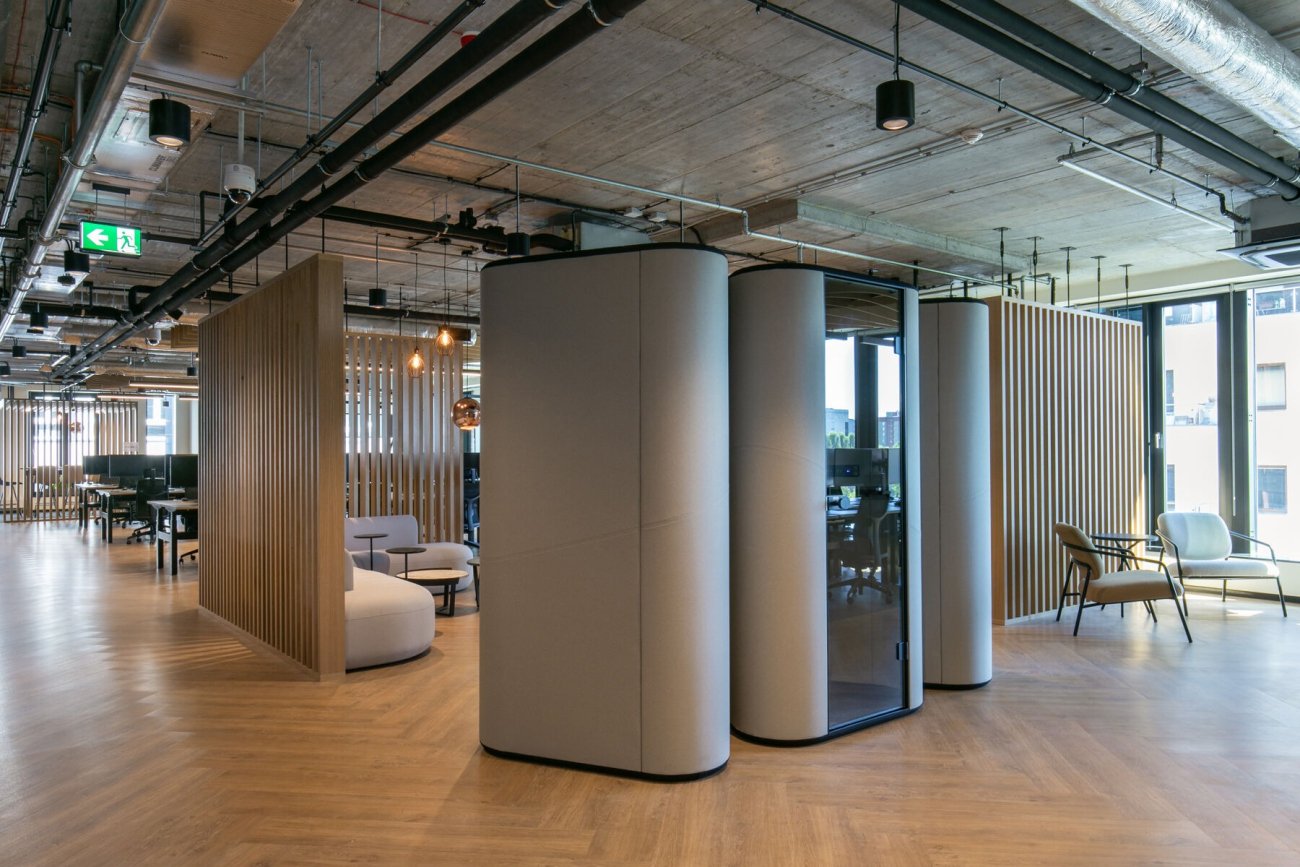 Grey upholstered acoustic booth in an open-plan space
Three pillars of effective acoustics
------------------------------------
To transform an open-plan office into a space conducive to concentration and comfortable working, a comprehensive approach is required, based on three complementary pillars:
**1. Absorb**
Reduce reverberation and echo.
Use materials with a high sound absorption coefficient NRC ≥ 0.80 on ceilings and walls to achieve a reverberation time RT60 in the range of 0.4-0.6 s.
Effect: less reflected noise and clearer speech.
**2. Block**
Separate loud sounds from quiet ones.
Introduce activity-based working (ABW) zones, acoustic booths and desk screens.
Effect: privacy for conversations and less sound transmission between workstations.
**3. Cover**
Control what cannot be silenced.
Use a sound masking system that reduces speech intelligibility (STI) and minimises distraction.
Effect: consistent, quiet acoustic background conducive to concentration.
Office acoustics implementation checklist
-----------------------------------------
The following steps will help the Facility Manager or Operations Director to effectively plan and implement acoustic optimisation:
1. **Initial audit** - Commission noise measurements (Leq, RT60, STI) from an accredited laboratory to assess compliance with the PN-N-01307:1994 standard.
2. **Acoustic design** - Take acoustic requirements into account at the office design stage to avoid costly alterations.
3. **Zoning and working rules (ABW)** - Designate zones for quiet, meetings and communication. Establish clear rules for the use of each zone.
4. **Passive investments** - Cover the main surfaces (ceilings, walls) with materials with NRC/αw ≥ 0.80 to reduce reverberation and reflected noise.
5. **Technical insulation** - Soundproof installation noise sources such as HVAC and server rooms.
6. **Active investments** - Install a sound masking system (Direct-Field or Plenum) in open areas to improve acoustic comfort.
7. **Impact assessment (ROI)** - Regularly monitor productivity, absenteeism and employee satisfaction indicators to assess the return on investment and confirm the improvement in efficiency.
 ### Author
.mdd
.mdd is an innovative and versatile partner supporting the growth of your business.
[
New products: outdoor furniture ](https://mdd.eu/en/blog/news-july-outdoors-2024-en) [ New products: Ogi Drive with felt panels, new Leo price, and new configuration options
](https://mdd.eu/en/blog/new-products-ogi-drive-with-felt-panels-new-leo-price-and-ne)
Sign up for our newsletter I consent to the processing of my personal data for marketing purposes. I have read and accept the Privacy Policy.
It looks like you're browsing from the United Kingdom
You're currently viewing prices in EUR €. Would you like to wait to GBP ₤ for accurate pricing and shipping options?
✕
switch to GBP ₤continue in EUR €
Contact [ +48 693 003 016 ](tel:+48693003016) [ shop@mdd.eu ](mailto:shop@mdd.eu)
Follow us on [ ](https://www.facebook.com/mddofficefurniture) [ ](https://www.instagram.com/mdd_furniture/) [ ](https://www.linkedin.com/company/mdd/) [ ](https://www.pinterest.com/mddoffice/)
Products [ Products ](/en/products/) [ Seating ](/en/seating/) [ Reception desks ](/en/receptions/reception-desks/) [ Desks ](/en/desks/) [ Height adjustable Desks ](/en/desks/height-adjustable-desks/) [ Tables ](/en/tables/) [ Booths ](/en/acoustics/acoustic-pods/) [ Storage furniture ](/en/cabinets-and-pedestals/)
Tools and Support [ Proper furniture care ](/en/proper-furniture-care/) [ Linx ](https://www.mddlinx.com/?jezyk=EN) [ Price list ](https://pricelist.mdd.pl/pricelist/en/) [ Pcon Planner ](/en/pcon-planner/) [ Digital tools ](/en/digital-tools/) [ Image Bank ](/en/image-bank/) [ FAQ ](/en/faq/) [ Order swatches ](/en/swatches-and-sample-sets/) [ Submit claim ](/en/report-a-complaint/?lang=EN)
About .mdd [ News and blog ](/en/blog/) [ Sustainability ](/en/sustainability/) [ Press ](/en/infoandpress/) [ Designers ](/en/our-designers/) [ About us ](/en/about-us/) [ Contact ](/en/contact/)
Legal Information [ Terms of use ](/en/terms-of-use/) [ Cookies policy ](/en/cookies-policy/) [ Privacy policy ](/en/general-privacy-policy/)
European Union © .mdd 2026
Change region
Select your language
[Polish](https://mdd.pl/) [English](https://mdd.eu/en/) [German](https://mdd.eu/de/) [French](https://mdd.eu/fr/) [Italian](https://mdd.eu/it/) [Spanish](https://mdd.eu/es/)
- Consent
- Adjust
- About cookies
This website uses cookies
We use cookies to personalise content and ads, to provide social media features and to analyse our traffic. We also share information about your use of our site with our social media, advertising and analytics partners, who may combine it with other information that you’ve provided to them or that they’ve collected from your use of their services.
Essential
Essential cookies contribute to the usability of the website by enabling basic functions such as site navigation and access to secure areas of the website. Without those cookies, the website cannot function properly.
Statistic
Statistic cookies help the website owner understand how users behave on the website, collecting and reporting anonymous information.
Google 3
[Learn more about this provider](https://policies.google.com/privacy)\_gid
Registers a unique ID that is used to generate statistical data on how the visitor uses the website.
Expiry: 1 day
Type: HTTP
\_ga
Registers a unique ID that is used to generate statistical data on how the visitor uses the website.
Expiry: 399 days
Type: HTTP
\_ga\_#
Used by Google Analytics to collect data on the number of times a user has visited the website as well as dates for the first and most recent visit.
Expiry: 399 days
Type: HTTP
Marketing
Marketing cookies are used to track users on the website. The aim is to display advertisements that are relevant and interesting for individual users and thus more valuable to third-party publishers and advertisers. [Learn more about Google's Privacy Policy.](https://business.safety.google/privacy/)
Google 1
[Learn more about this provider](https://pl-pl.facebook.com/privacy/policy/?entry_point=facebook_page_footer)\_gcl\_au
Used by Google AdSense for experimenting with advertisement efficiency across websites using their services.
Expiry: 3 months
Type: HTTP
Facebook 1
\_fbp
Used by Facebook to deliver a series of advertisement products such as real-time bidding from third-party advertisers.
Expiry: 399 days
Type: HTTP
Cookies are small text files that can be used by websites to make a user's experience more efficient. The law states that we can store cookies on your device if they are strictly necessary for the operation of this site. For all other types of cookies, we need your permission. This means that cookies, which are categorized as necessary, are processed based on GDPR Art. 6 (1) (f). All other cookies, meaning those from the categories preferences and marketing, are processed based on GDPR Art. 6 (1) (a) GDPR. This site uses different types of cookies. Some cookies are placed by third-party services that appear on our pages. You can at any time change or withdraw your consent from the Cookie Declaration on our website. Learn more about who we are, how you can contact us and how we process personal data in our Privacy Policy. Please state your consent ID and the date when you contact us regarding your consent.
Reject Consent Accept all Accept checked