Quiet zones in open-plan offices: a guide to effective office acoustics | .mdd
[ ](https://mdd.eu/gb/) - [ Products ](/gb/products/) Products
Categories
[ New products ](/gb/new-products/)
[ Outdoor ](/gb/outdoor/) Outdoor
[ All ](/gb/outdoor/) [Outdoor seating](/gb/outdoor/seating/) [Outdoor tables](/gb/outdoor/tables/) [Accessories for outdoor furniture](/gb/outdoor/accessories-for-outdoor-furniture/)
[ Seating ](/gb/seating/) Seating
[ All ](/gb/seating/) [Office chairs](/gb/seating/office-chairs/) [Meeting chairs](/gb/seating/meeting-chairs/) [High stools](/gb/seating/high-stools/) [Kitchen and dining chairs](/gb/seating/kitchen-chairs/) [Stackable chairs](/gb/seating/stackable-chairs/) [Sofas](/gb/seating/sofas/) [Armchairs](/gb/seating/armchairs/) [Poufs](/gb/seating/poufs/) [Lounge](/gb/seating/lounge/) [Benches](/gb/seating/benches/) [Footrests](/gb/seating/footrests/) [Wooden seats](/gb/seating/wooden-seats/) [Plastic chairs](/gb/seating/plastic-chairs/) [Accessories for seating](/gb/seating/accessories-for-seating/)
[ Receptions ](/gb/receptions/) Receptions
[ All ](/gb/receptions/) [Reception desks](/gb/receptions/reception-desks/) [Accessories for reception desks](/gb/receptions/accessories-for-reception-desks/)
[ Desks ](/gb/desks/) Desks
[ All ](/gb/desks/) [Height adjustable Desks](/gb/desks/height-adjustable-desks/) [One-station desks](/gb/desks/one-station-desks/) [Bench desks](/gb/desks/bench-desks/) [Desks with storage](/gb/desks/desks-with-storage/) [Desks Systems](/gb/desks/desk-systems/) [Executive desk](/gb/desks/executive-desk/) [Accessories for desks](/gb/desks/accessories-for-desks/)
[ Storage furniture ](/gb/cabinets-and-pedestals/) Storage furniture
[ All ](/gb/cabinets-and-pedestals/) [Pedestals](/gb/cabinets-and-pedestals/pedestals/) [Cabinets](/gb/cabinets-and-pedestals/cabinets/) [Storage cabinets](/gb/cabinets-and-pedestals/storage-cabinets/) [Bookcases](/gb/cabinets-and-pedestals/bookcases/) [Wardrobes](/gb/cabinets-and-pedestals/wardrobes/) [Glass-door cabinets](/gb/cabinets-and-pedestals/glass-door-cabinets/) [Executive cabinets](/gb/cabinets-and-pedestals/executive-cabinets/) [Coat racks](/gb/cabinets-and-pedestals/coat-racks/) [Plant pots](/gb/cabinets-and-pedestals/plant-pots/) [Accessories for storage](/gb/cabinets-and-pedestals/accessories-for-storage/)
[ Acoustics ](/gb/acoustics/) Acoustics
[ All ](/gb/acoustics/) [Booths](/gb/acoustics/acoustic-pods/) [Freestanding screens](/gb/acoustics/freestanding-screens/) [Acoustic wall and ceiling panels](/gb/acoustics/wall-panels/) [Desk screens](/gb/acoustics/desk-panels/) [Meeting cubicles](/gb/acoustics/meeting-cubicles/) [Accessories for acoustics](/gb/acoustics/accessories-for-acoustics/)
[ Tables ](/gb/tables/) Tables
[ All ](/gb/tables/) [Dining tables](/gb/tables/dining-tables/) [Coffee tables](/gb/tables/coffee-tables/) [Café tables](/gb/tables/cafe-tables/) [High tables](/gb/tables/high-tables/) [Executive tables](/gb/tables/executive-tables/) [Folding tables](/gb/tables/folding-tables/) [Conference tables](/gb/tables/conference-tables/) [Modular tables](/gb/tables/extendable-tables/) [Multimedia station](/gb/tables/multimedia-station/) [Side tables](/gb/tables/side-tables/) [Accessories for tables](/gb/tables/accessories-for-tables/)
[ Lamps ](/gb/lamps/)
[ Tamo ](https://mdd.eu/gb/tamo/) Tamo
[ All ](https://mdd.eu/gb/tamo/) [ Seating ](https://mdd.eu/gb/tamo/seating/) [ Wooden seats ](https://mdd.eu/gb/tamo/wooden-seats/) [ Wooden desks ](https://mdd.eu/gb/tamo/desks/) [ Wooden tables ](https://mdd.eu/gb/tamo/tables-and-side-tables/) [ Storage ](https://mdd.eu/gb/tamo/storage/) [ Lamps ](https://mdd.eu/gb/tamo/lamps/) [ Accessories ](https://mdd.eu/gb/tamo/accessories/)
[All furniture](/en/products/)
- [ Collections ](/gb/collections/) Collections
Collections
[ All ](/gb/collections/)
[ Seating ](/gb/collections/seating/)
[ Desks ](/gb/collections/desks/)
[ Executive Office ](/gb/collections/executive-office/)
[ Outdoor ](/gb/collections/outdoor/)
- [ CustomerProjects ](/gb/realizations/)
- [ For Architects ](/gb/programme-for-architects/) For Architects
For Architects
[ Image Bank ](/gb/image-bank/)
[ Order Swatches ](/gb/swatches-and-sample-sets/)
[ Digital Tools ](/gb/digital-tools/)
- [ B2B ](/gb/b2b/) B2B
B2B
[ Linx ](https://www.mddlinx.com/?jezyk=en)
[ B2B ](/gb/b2b/)
[ Product Feed ](/gb/product-feed/)
- [ About Us ](/gb/about-us/) About Us
About Us
[ Designers ](/gb/our-designers/)
[ Sustainability ](/gb/sustainability/)
- [ Contact ](/gb/contact/)
[ My account ](/en/customer/login/) [ Enquiries ](https://mdd.eu/gb/productenquiry/index/index/) [ Offer ](https://mdd.eu/gb/offers/)
![]()
$refs.search.focus())" @click.away="isSearchActive = false" class="lg:c-hidden c-flex c-h-full c-cursor-pointer c-items-center c-px-2" >
[ ](/en/customer/login/)
0 && changeCartOpenState($dispatch)" class="c-h-full c-px-2"> 1
#### Product Enquiry
Amount of products: 1
![]() ![]()
Paralel
Quantity:
i.id) : [item.id], item.quantity)">
i.id) : [item.id], item.quantity)"> i.id) : [item.id], item.quantity)">
deleteItemFromCart(item.productType === 'grouped' ? item.items.map(i => i.id) : [item.id]), message: 'Are you sure you want to remove this product from your enquiry?' })"> Delete
Inc VAT
Sum:
[ See the product enquiry](https://mdd.eu/gb/productenquiry/index/index/)
0 && changeCartOpenState($dispatch)" class="c-h-full c-px-2">
#### Quotation
Amount of products:
![]()
[ Go to quotation ](https://mdd.eu/gb/offers/)
0 && changeCartOpenState($dispatch)" class="c-h-full c-px-2">
#### Shopping cart
Amount of products: 1
![]()
Quantity:
deleteItemFromCart(index), message: 'Are you sure you want to remove this product from your cart?' })"> Delete
Sum:
[ Proceed to cart ](https://mdd.eu/gb/app/cart/)
Select your region to check prices in your currency, VAT rate, and shipping costs.
Austria
Belgium
Bulgaria
Croatia
Czechia
Denmark
Estonia
Finland
France
Germany
Greece
Hungary
Italy
Ireland
Lithuania
Luxembourg
Latvia
Netherlands
Norway
Poland
Portugal
Romania
Slovakia
Slovenia
Spain
Sweden
Switzerland
United Kingdom
United States
Other regions
Czy napewno chcesz usunąć ten produkt z zapytania?
Cancel Delete
![]() ![]() deleteItemFromCart(index), message: 'Are you sure you want to remove this product from comparison?' })">
[View comparison
](/en/comparison)
[ View comparison
](/comparison) deleteAllItemsFromCart(), message: 'Are you sure you want to remove all products from comparison? ' })"> Clear all
[ ](https://mdd.eu/gb/) › [News and Blog](https://mdd.eu/gb/blog) › Quiet zones in open-plan offices: a guide to effec...
News
Quiet zones in open-plan offices: a guide to effective office acoustics
=======================================================================
Learn how to divide your office into acoustic zones to reduce noise, improve concentration and maintain spatial flexibility.
2025.12.09 15m Views: 2659
- [ Acoustic zones in action: the flexible hybrid office ](#blog-post-title-with-description-12238)
- [ What is zonal acoustic design and why is it important in hybrid offices? ](#blog-post-title-with-description-12239)
- [ What are the types of functional zones in a modern office? ](#blog-post-title-with-description-12240)
- [ Legal and technical framework for office acoustics: critical indicators ](#blog-post-title-description-image-vertically-12241)
- [ What Polish standards regulate office acoustics? ](#blog-post-title-with-description-12242)
- [ What is ISO 3382-3 and what parameters does it define? ](#blog-post-title-with-description-12243)
- [ What are the sound insulation requirements for partitions in offices? ](#blog-post-title-with-description-12244)
- [ Pillar I: Passive sound control and zonal absorption ](#blog-post-title-description-image-vertically-12245)
- [ How do sound-absorbing materials reduce reverberation in an office? ](#blog-post-title-with-description-12246)
- [ What office accessories support room acoustics? ](#blog-post-title-with-description-12247)
- [ What is acoustic furniture and how does it support focused zones? ](#blog-post-title-with-description-12248)
- [ Pillar II: Active isolation and flexible barriers ](#blog-post-title-description-image-vertically-12249)
- [ How do mobile acoustic partitions support the flexibility of a hybrid office? ](#blog-post-title-with-description-12250)
- [ What are the technical features of acoustic booths that ensure insulation? ](#blog-post-title-with-description-12251)
- [ Pillar III: Active acoustic management – sound masking systems ](#blog-post-title-description-image-vertically-12252)
- [ What are sound masking systems and how do they work? ](#blog-post-title-with-description-12253)
- [ How do masking systems improve privacy and concentration? ](#blog-post-title-with-description-12254)
- [ What variants of masking systems are available? ](#blog-post-title-with-description-12255)
- [ Implementation matrix: Acoustic optimisation for zones ](#blog-post-title-description-image-vertically-12256)
- [ How to tailor acoustic solutions to different office zones? ](#blog-post-title-with-description-12257)
- [ How to verify the effectiveness of implemented acoustic solutions? ](#blog-post-title-with-description-12258)
- [ Final conclusions and implementation recommendations ](#blog-post-title-description-image-vertically-12259)
- [ What is a comprehensive strategy for implementing zonal acoustic design? ](#blog-post-title-with-description-12260)
- [ Is acoustic design a strategic investment in human capital? ](#blog-post-title-with-description-12261)
- [ How to finance and plan the implementation of zonal acoustic design? ](#blog-post-title-with-description-12262)
Acoustic zones in action: the flexible hybrid office
----------------------------------------------------
Modern offices, with their open spaces and flexibility, pose a challenge for effective acoustic management. Open-plan offices, although designed to promote interaction and flexibility in layout, often become a source of functional and sensory problems. The main factors that undermine their advantages are excessive noise, chronic lack of privacy and sensory overload, leading to reduced productivity and comfort for employees.
What is zonal acoustic design and why is it important in hybrid offices?
------------------------------------------------------------------------
In response to these challenges, the need for zoning has emerged, the key premise of which is to transform open space into a controlled mosaic. Dividing the office into functional zones not only organises the space, but also defines and optimises how it is used, ensuring that each part has its own precise meaning and purpose.
The principle of ‘Separate, but don't divide!’ is at the core of modern acoustic design for hybrid offices. It focuses on achieving sensory and functional separation – key to concentration and privacy – using acoustic measures and flexible barriers, while eliminating the need for permanent, rigid physical walls. Separation is therefore achieved at the sound level, not just at the structural level.
What are the types of functional zones in a modern office?
----------------------------------------------------------
Effective acoustic management requires precise definition of work environments and assigning specific acoustic requirements to them:
- Focus Zone: areas designed for work requiring high concentration, such as programming, report writing or analytical tasks. These zones are characterised by the lowest permissible background noise level (35-40 dB);
- Collaboration Zone: open or semi-open spaces designed for brainstorming and discussion. Although they accept higher sound levels, it is critical to use intensive absorption to prevent noise from radiating into adjacent, sensitive zones;
- Hub Zone: main desk-based work areas characterised by moderate noise and constant movement (e.g. customer service, administration). In this zone, the priority is effective speech intelligibility management (40-55 dB);
- Privacy/Phone Booth Zone: small, enclosed units, such as acoustic booths, designed for confidential phone calls, video conferencing and difficult tasks requiring almost complete silence (30-35 dB).
The discrepancy between legal standards and cognitive needs necessitates zonal separation. Although the acceptable equivalent sound level for standard administrative work may be ≤ 55 dB, ergonomic requirements for complex and difficult tasks range from 35 to 55 dB. Since open-plan offices are unable to naturally maintain such low background noise levels, designers are forced to introduce physical or sensory separation.
Legal and technical framework for office acoustics: critical indicators
-----------------------------------------------------------------------
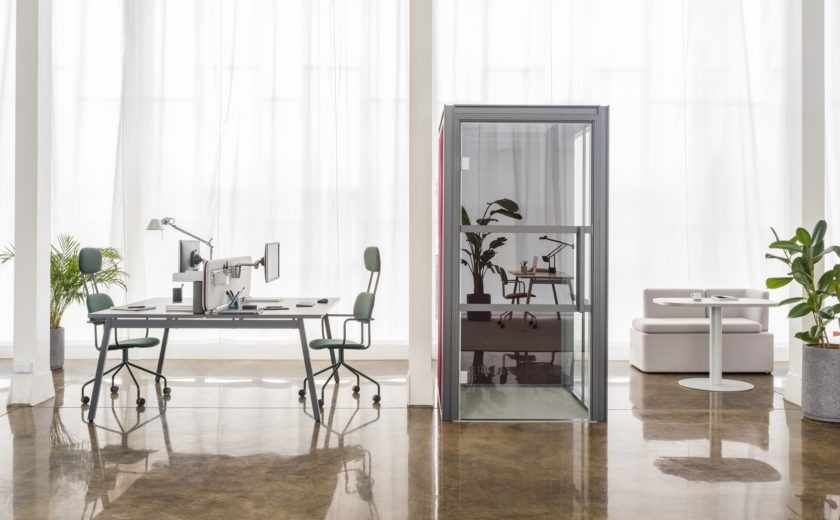 Office space equipped with an acoustic booth and a double workstation
What Polish standards regulate office acoustics?
------------------------------------------------
Zonal acoustics design must be embedded in a rigorous legal and technical framework that defines acceptable sound levels and room characteristics.
Polish standards define maximum equivalent sound levels (L\_Aeq,T) during working hours:
- PN-N-01307:1994: Sets permissible values at ≤ 55 dB for administrative and office buildings intended for conceptual work and ≤ 65 dB for secretariats and customer service offices.
- PN-EN ISO 9241-6:2002: Emphasises ergonomic requirements for computer workstations, where the sound level should not exceed 55 dB when performing difficult and complex tasks, with recommended lower limits reaching 35 dB.
- PN-B-02151-2:2018 (for open-plan offices): The reference equivalent A-weighted sound level is 40 dB. This value is often adjusted to account for the reverberation time of the room. Studies show that for typical open-plan offices, the acceptable sound level is in the range of 35-39 dB.
What is ISO 3382-3 and what parameters does it define?
------------------------------------------------------
The PN-EN ISO 3382-3:2012 standard is crucial for assessing open space acoustic environments, as it focuses not only on the overall noise level, but above all on the propagation and distracting nature of speech.
The key parameters of this standard are:
- Speech Diffusion Radius (r\_D): This is the distance from the speaker beyond which speech intelligibility decreases rapidly. Reducing r\_D is the direct goal of zonal acoustics design, as it shortens the area of distraction,
- Speech Sound Level at 4 metres (L\_p,A,S,4m): The standard imposes a limit on the A-weighted speech sound level at a distance of 4 m to a maximum of 48 dB. This parameter indicates how far speech from a given position can be heard and is distracting,
- Minimum Sound Absorption: Requirements for acceptable reverberation noise specify the minimum unit sound absorption of a room in the range of 1.1-1.3 m².
What are the sound insulation requirements for partitions in offices?
---------------------------------------------------------------------
In the case of offices, regardless of the type of building, the sound insulation requirements are the same as for office buildings. According to PN-B-02151-3:2015-10, the minimum sound insulation index (R'\_A,1) for partitions between office rooms, meeting rooms and conference rooms should be ≥ 40 dB, with the possibility of reducing it to ≥ 35 dB under certain conditions. This is a basic requirement that must be met, even when using mobile or glass partitions.
Table 1: Summary of Normative Requirements for Office Acoustics
Reference standard Area of application Required acoustic parameter Permissible / recommended value PN-N-01307:1994
Conceptual and administrative work Equivalent sound level L\_Aeq,T ≤ 55 dB
PN-EN ISO 9241-6:2002
Difficult and complex tasks (Focus Zone) Sound level L\_Aeq,T 35-55 dB
PN-EN ISO 3382-3:2012
Acoustic properties of open spaces Speech sound level at 4 m (L\_p,A,S,4m) ≤ 48 dB
PN-B-02151-3:2015-10
Acoustic insulation of partitions Sound insulation index R'\_A,1 ≥ 40 dB
PN-B-02151-4:2015
Permissible reverberation noise Unit sound absorption ≥ 1.1 - 1.3 m²
Pillar I: Passive sound control and zonal absorption
----------------------------------------------------
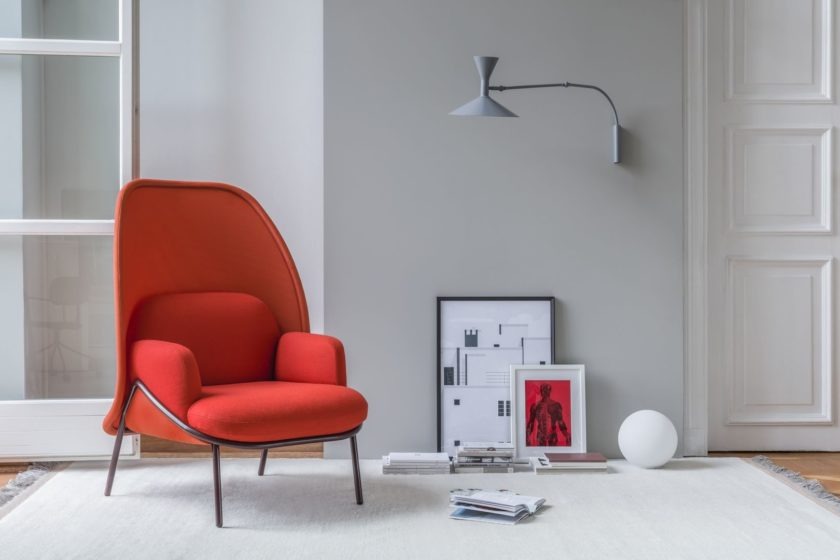 Armchair with a high backrest functioning as an acoustic shield
How do sound-absorbing materials reduce reverberation in an office?
-------------------------------------------------------------------
Passive acoustic solutions are the foundation of effective zonal design, as they are designed to reduce reverberation (i.e. the time it takes for acoustic energy to decay in a room) and shorten the propagation time of sound waves. This mechanism directly improves speech propagation indices as defined by ISO 3382-3.
In order to increase the acoustic absorption of a room to the required level, materials that actively prevent the reflection of sound waves must be used consistently. Soft floor coverings are key here: carpets and rugs work much better than hard tiles because they significantly reduce noise transmission and reflection.
What office accessories support room acoustics?
-----------------------------------------------
In terms of architectural finishes, it is essential to use wall and ceiling panels with a high absorption coefficient (class A). Aesthetic solutions, such as perforated wooden acoustic panels, effectively combine natural beauty with acoustic requirements. These panels not only reduce unwanted noise, but also add elegance, being particularly recommended for collaboration areas and conference rooms.
Office furniture plays a dual role – functional and acoustic – enabling passive separation in line with the principle of ‘Separate, but don't divide!’. Upholstered furniture, including sofas, armchairs and seats made of soft materials, are natural sound absorbers, helping to reduce background noise.
What is acoustic furniture and how does it support focused zones?
-----------------------------------------------------------------
Furniture with high acoustic walls (so-called soft seating), such as the Kaiva and Agora series of acoustic booths, allows you to create micro-environments. They act as passive separation, dampening ambient noise and offering the user visual protection, which is essential for maintaining a high level of concentration in the Concentration Zone.
This is complemented by partition walls and screens placed between desks. Their use helps to dampen sounds from the immediate environment, effectively creating a more focused workspace without the need to completely enclose the workstation.
Current acoustic design is evolving in a holistic direction. Solutions such as greenery in the office and space branding elements are deliberately combined with sound-absorbing materials. The introduction of these elements suggests that contemporary office design aims to improve not only technical parameters (dB reduction) but also visual and sensory comfort.
Pillar II: Active isolation and flexible barriers
-------------------------------------------------
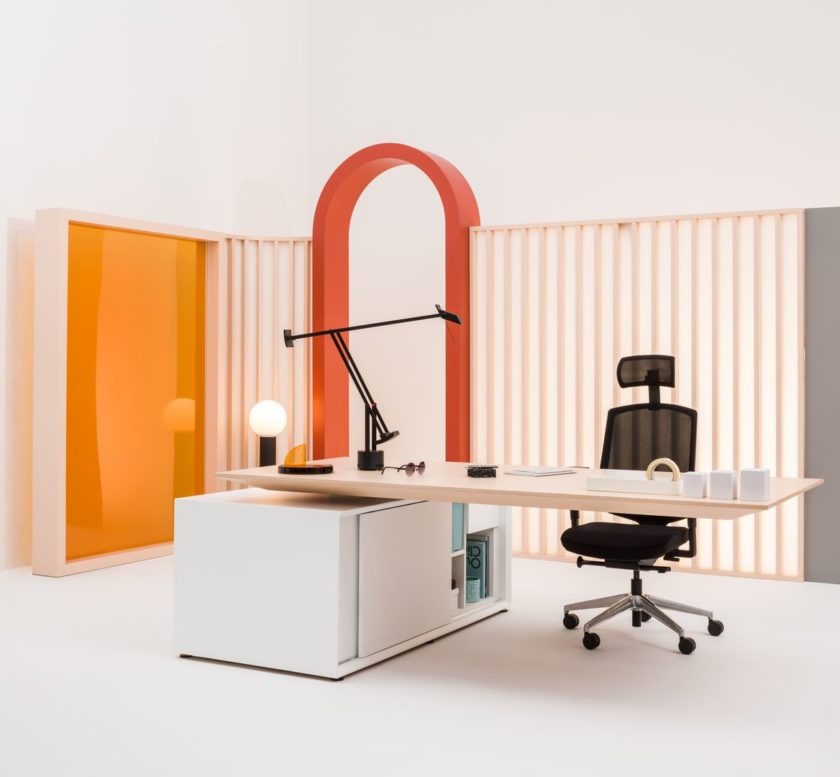 Managerial office space separated by panels
How do mobile acoustic partitions support the flexibility of a hybrid office?
-----------------------------------------------------------------------------
While passive absorption controls reverberation in a room, active insulation aims to block sound transfer between zones, implementing the idea of flexible, temporary separation.
Mobile acoustic partitions are invaluable in managing the dynamics of office space. Their lightweight and mobile design allows for the quick creation of quiet zones for individual or group work. This is key to the flexible management of a hybrid office, allowing for easy rearrangement of space according to current needs, for example during workshops, meetings, or to temporarily create a quiet zone. These partitions can be either transparent or fabric-based, but their effectiveness depends on their absorption and insulation parameters.
What are the technical features of acoustic booths that ensure insulation?
--------------------------------------------------------------------------
Multifunctional [acoustic booths](https://mdd.eu/gb/acoustics/acoustic-pods/) and cubicles are the most effective way to create a quiet, private space in an open working environment. They provide maximum sound insulation, which is essential for conducting confidential meetings and video conferences without interference. The critical insulation performance of modern booths reaches 35 dB, which allows for effective isolation from the environment.
Achieving high insulation in booths requires the elimination of so-called flanking paths. The most important technological solutions in this area are:
- Triplex Glass of Variable Thickness: The use of three-layer, safety triplex glass with varying layer thicknesses is fundamental. The varying thickness of the layers prevents resonance at specific sound frequencies, enabling effective blocking of a wide spectrum of sound waves.
- Ventilation Silencers: The ventilation system is a potential weak point in insulation. Air must enter the cabin through special acoustic silencers that actively block noise from escaping outside and inside. At the same time, a quiet fan must ensure effective air exchange, renewing up to 30 m³ of air per hour, eliminating CO₂ stagnation.
- Elimination of Internal Echo: To ensure a comfortable environment inside the cabin, its interior must be lined with sound-absorbing materials that effectively dampen echo and reverberation.
- Smart Automation: Modern cabins are equipped with presence detection systems that automatically turn lighting and ventilation on and off (e.g. after 6-8 minutes), optimising energy consumption and increasing user comfort.
Pillar III: Active acoustic management – sound masking systems
--------------------------------------------------------------
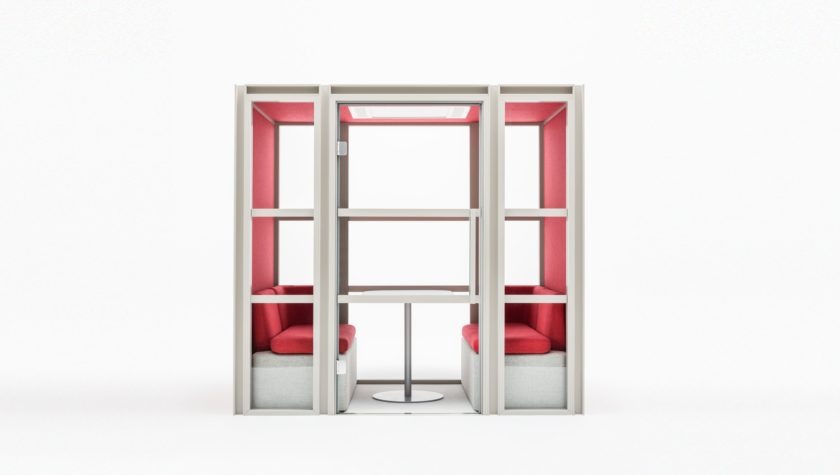 Acoustic booth for meetings
What are sound masking systems and how do they work?
----------------------------------------------------
Sound masking systems represent the most advanced method of implementing the principle of ‘Separate, but do not divide!’, as they manage acoustic information (speech) without introducing physical barriers. These solutions are ideal for administrative areas and open ‘Hub Zones’ where complete silence is impossible or undesirable.
The operation of masking systems is based on two natural phenomena of hearing physiology:
- Acoustic masking: this phenomenon consists in the fact that a sound with a higher intensity level (controlled noise emitted by the system) effectively drowns out other sounds with a similar bandwidth (e.g. human speech), making them incomprehensible.
- Auditory adaptation: the human brain is able to ignore monotonous and constant sounds, such as uniform noise. The system emits controlled noise with specially shaped characteristics, tailored to the environment. The brain adapts to this background noise, minimising the distracting effect of ambient noise, such as conversations or ringing telephones.
How do masking systems improve privacy and concentration?
---------------------------------------------------------
Controlled noise effectively reduces the intelligibility of speech and other distracting sounds. As a result, the privacy of conversations in open spaces is increased, which is crucial, for example, in customer service offices or in situations where the content of conversations should not be heard by bystanders.
In a normative context, a sound masking system allows for a controlled increase in background noise, which leads to a faster decrease in speech sound levels at a distance. This improves key acoustic indicators defined by PN-EN ISO 3382-3 (e.g. r\_D) without the need for additional physical barriers.
In offices where very high absorption (minimum reverberation) has been achieved, the so-called ‘library effect’ often occurs; every sound, even quiet ones, is immediately distracting. The masking system prevents this by introducing a constant, comfortable level of background noise that simultaneously suppresses distractions, increasing concentration and work efficiency.
What variants of masking systems are available?
-----------------------------------------------
These systems are available in flexible configurations, from single-zone (e.g. CMS-II-1Ch) to dual-zone (e.g. CMS-II-2Ch), allowing for precise zoning of the masking level and adaptation to the local acoustic requirements of individual office areas. In addition, the masking system can act as a public address system, allowing the playback of background music, announcements, or other audio content.
Implementation matrix: Acoustic optimisation for zones
------------------------------------------------------
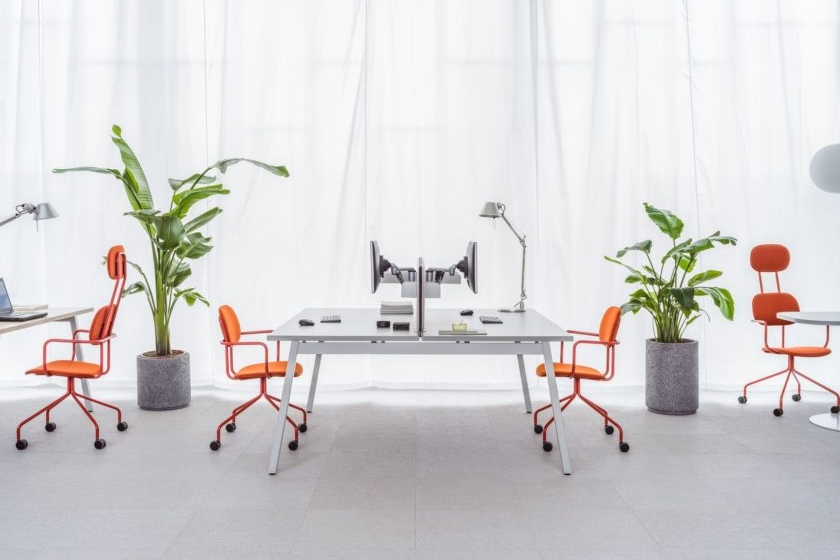
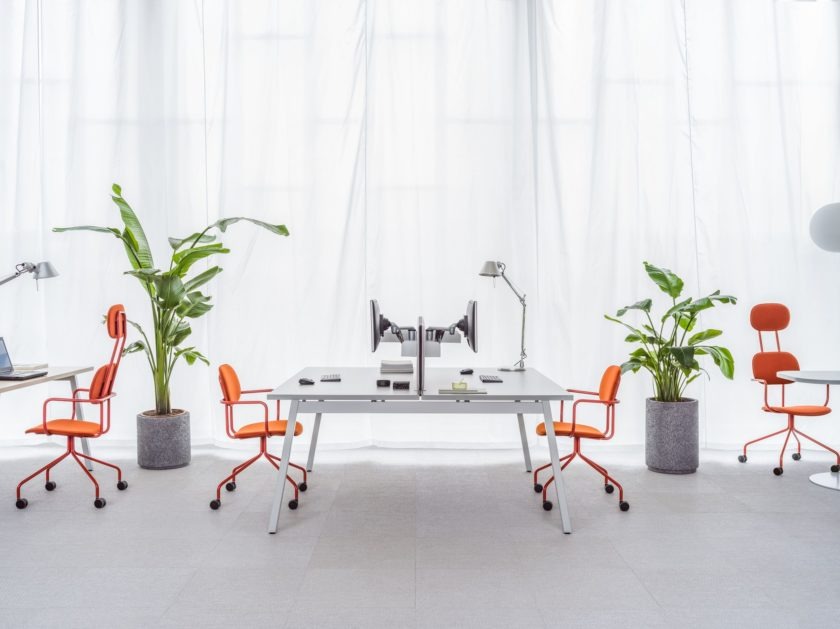 Open-plan office with neutral bench desks and orange chairs
How to tailor acoustic solutions to different office zones?
-----------------------------------------------------------
Effective zoning requires strategic alignment of acoustic technologies with the function of each zone. The matrix integrates normative objectives with available solutions, creating an action plan for managing the sound environment.
Table 2: Acoustic optimisation matrix for a zonal office
Office functional zone Main acoustic objective (L\_Aeq,T) Key zone parameters (PN/ISO) Leading passive/insulation solution Leading active solution (separation) Focus zone Very low 35-40 dB Minimum r\_D (fast speech attenuation) High-back armchairs/sofas, AW-class wall and ceiling panels Sound masking systems, mobile partitions Administrative zone (Hub) Controlled 40-55 dB Speech intelligibility limitation (L\_p,A,S,4m ≤ 48 dB) Carpets, desk screens, ceiling panels Sound masking systems (CMS) Collaboration zone Sound radiation control High absorption level (reverberation minimisation) Wall absorption (perforated panels), acoustic sofas, carpets None/public address system (optional) Isolation zone (Cubicles/booths) Maximum isolation 30-35 dB Zero noise transfer (inside/outside) Triplex glass, insulated echo-absorbing walls Active ventilation with acoustic silencers, automation
How to verify the effectiveness of implemented acoustic solutions?
------------------------------------------------------------------
The introduction of zonal acoustics requires rigorous verification. The technical design must take into account all mandatory elements and requirements in accordance with applicable regulations.
The acoustic properties of an office should be assessed in accordance with PN-EN ISO 3382-3:2012. This standard allows for a more reliable assessment by taking into account the grouping of workstations, which makes it possible to ignore the impact on the assessment of areas where work is not actually performed.
Table 3: Critical Characteristics of Insulation Elements
Acoustic element Technical criterion
Functional purpose
Impact on office efficiency
Booth glass (Triplex)
Three-layer, varying layer thickness
Prevention of resonance and loss of insulation in a wide band
Maintaining sound insulation at 35 dB
Booth ventilation
Special acoustic silencers in ventilation ducts
Blocking noise transmission (Flanking Path)
Ensuring quiet inside and outside the booth
Sound masking
Controlled noise with specially shaped characteristics
Reduction of speech intelligibility and increase in acoustic background
Increasing conversation privacy and concentration
Acoustic furniture (Soft Seating)
High acoustic walls, absorbent materials
Creation of a semi-open acoustic shield and reverberation suppression
Reducing noise and improving concentration
Final conclusions and implementation recommendations
----------------------------------------------------
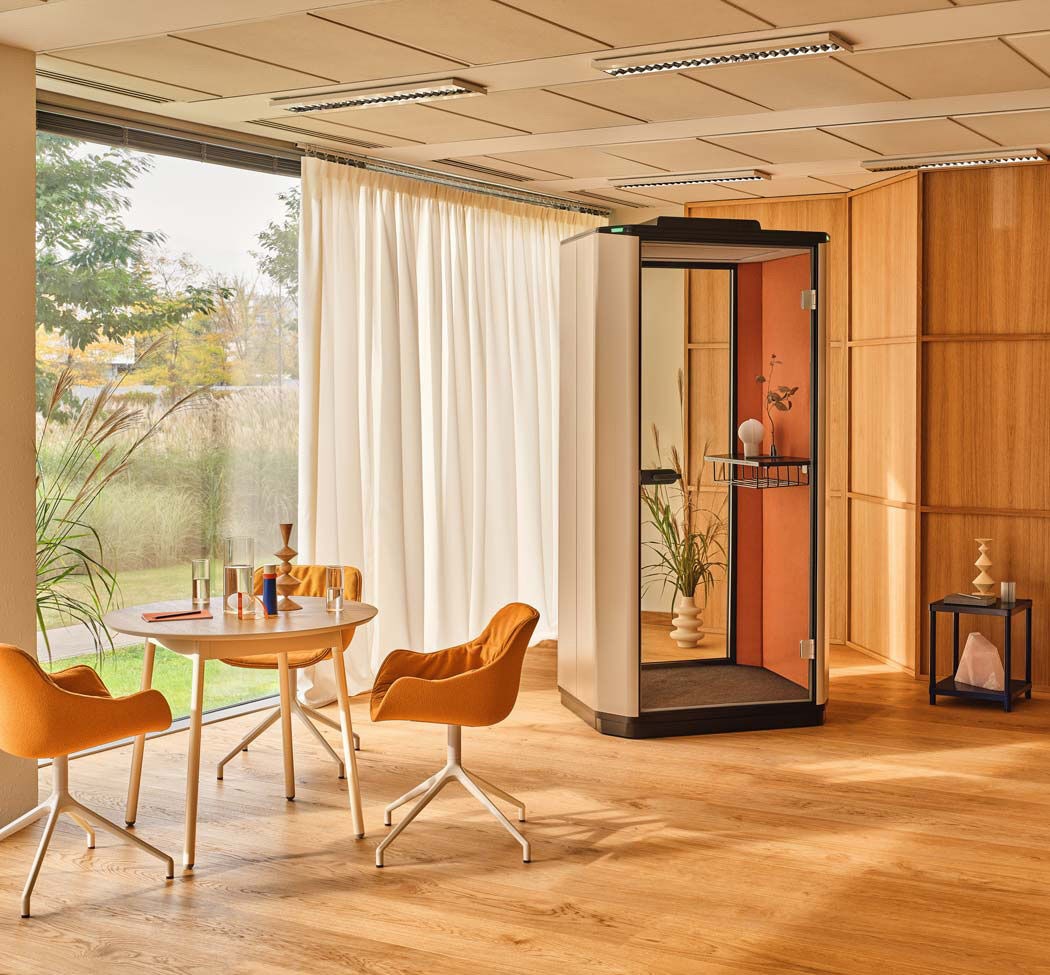 Office lounge area with an acoustic booth, finished with wooden panels
What is a comprehensive strategy for implementing zonal acoustic design?
------------------------------------------------------------------------
The principle of ‘Separate, but do not divide!’ in acoustic design for hybrid offices is achieved through the synthesis of three complementary pillars: passive absorption, flexible insulation and active sound management.
Key recommendations:
- Maximise reverberation control: It is necessary to strive for high unit sound absorption (in accordance with PN-B-02151-4) by using floor coverings, ceiling and wall panels, and acoustic furniture. This is a prerequisite for achieving an effective reduction in speech sound levels.
- Use of flexible infrastructure: Providing micro-environments with high acoustic insulation (e.g. soundproof booths up to 35 dB) and mobile partitions allows for dynamic adaptation of space to changing work needs and management of zone division without permanent interference with the office layout.
- Active distraction management: The introduction of sound masking systems is the most modern method of reducing speech intelligibility in open work areas, which directly improves ISO 3382-3 parameters and increases the subjective comfort of employees. This system eliminates the risk of the ‘library effect’ by creating an acceptable, constant background noise.
Is acoustic design a strategic investment in human capital?
-----------------------------------------------------------
The implementation of advanced acoustic systems is a strategic investment in human capital efficiency. It is recommended to use analytical tools to quantitatively determine the cost-effectiveness of implementing sound masking systems by measuring the potential increase in work efficiency.
It should be emphasised that acoustic design should not be limited to meeting minimum legal requirements. Although achieving a level of 55 dB may comply with PN-N-01307, it is insufficient to protect employees performing complex cognitive tasks. Continuous exposure to noise, even within acceptable limits, contributes to stress and sensory overload. Striving for the rigorous targets of 35-40 dB in Concentration Zones (in accordance with PN-EN ISO 9241-6) is therefore crucial not only for optimising efficiency, but above all for ensuring an ergonomic and healthy working environment.
How to finance and plan the implementation of zonal acoustic design?
--------------------------------------------------------------------
Strategic implementation planning requires:
1. acoustic audit: conducting professional noise level measurements in different areas of the office;
2. needs analysis: identifying priority areas (focus on Concentration Zones);
3. selection of solutions: choosing the right combination of passive, insulating and active solutions;
4. pilot implementation: testing solutions in one section before full implementation;
5. ROI evaluation: measuring improvements in productivity and employee satisfaction after implementation.
Proper zonal acoustic design transforms an open-plan office from a distracting environment into a diversified, acoustically optimised space that supports both focused work and flexible collaboration.
 ### Author
.mdd
.mdd is an innovative and versatile partner supporting the growth of your business.
[
Redefining space. Inspirations ](https://mdd.eu/gb/blog/redefining-space-inspirations1) [ Baltic in the words of the designer - Krystian Kowalski
](https://mdd.eu/gb/blog/baltic-in-the-words-of-the-designer-krystian-kowalski-gb)
Sign up for our newsletter I consent to the processing of my personal data for marketing purposes. I have read and accept the Privacy Policy.
It looks like you're browsing from the United Kingdom
You're currently viewing prices in EUR €. Would you like to wait to GBP ₤ for accurate pricing and shipping options?
✕
switch to GBP ₤continue in EUR €
Contact [ +48 693 003 016 ](tel:+48693003016) [ shop@mdd.eu ](mailto:shop@mdd.eu)
Follow us on [ ](https://www.facebook.com/mddofficefurniture) [ ](https://www.instagram.com/mdd_furniture/) [ ](https://www.linkedin.com/company/mdd/) [ ](https://www.pinterest.com/mddoffice/)
Products [ Products ](/gb/products/) [ Seating ](/gb/seating/) [ Reception desks ](/gb/receptions/reception-desks/) [ Desks ](/gb/desks/) [ Height adjustable Desks ](/gb/desks/height-adjustable-desks/) [ Tables ](/gb/tables/) [ Booths ](/gb/acoustics/acoustic-pods/) [ Storage furniture ](/gb/cabinets-and-pedestals/)
Tools and Support [ Proper furniture care ](/gb/proper-furniture-care/) [ Linx ](https://www.mddlinx.com/?jezyk=EN) [ Price list ](https://pricelist.mdd.pl/pricelist/gb/) [ Pcon Planner ](/gb/pcon-planner/) [ Digital tools ](/gb/digital-tools/) [ Image Bank ](/gb/image-bank/) [ FAQ ](/gb/faq/) [ Order swatches ](/gb/swatches-and-sample-sets/) [ Submit claim ](/gb/report-a-complaint/?lang=EN)
About .mdd [ News and blog ](/gb/blog/) [ Sustainability ](/gb/sustainability/) [ Press ](/gb/infoandpress/) [ Designers ](/gb/our-designers/) [ About us ](/gb/about-us/) [ Contact ](/gb/contact/)
Legal Information [ Terms of use ](/gb/terms-of-use/) [ Cookies policy ](/gb/cookies-policy/) [ Privacy policy ](/gb/general-privacy-policy/)
European Union © .mdd 2026
Change region
Select your language
[Polish](https://mdd.pl/) [English](https://mdd.eu/en/) [German](https://mdd.eu/de/) [French](https://mdd.eu/fr/) [Italian](https://mdd.eu/it/) [Spanish](https://mdd.eu/es/)
- Consent
- Adjust
- About cookies
This website uses cookies
We use cookies to personalise content and ads, to provide social media features and to analyse our traffic. We also share information about your use of our site with our social media, advertising and analytics partners, who may combine it with other information that you’ve provided to them or that they’ve collected from your use of their services.
Essential
Essential cookies contribute to the usability of the website by enabling basic functions such as site navigation and access to secure areas of the website. Without those cookies, the website cannot function properly.
Statistic
Statistic cookies help the website owner understand how users behave on the website, collecting and reporting anonymous information.
Google 3
[Learn more about this provider](https://policies.google.com/privacy)\_gid
Registers a unique ID that is used to generate statistical data on how the visitor uses the website.
Expiry: 1 day
Type: HTTP
\_ga
Registers a unique ID that is used to generate statistical data on how the visitor uses the website.
Expiry: 399 days
Type: HTTP
\_ga\_#
Used by Google Analytics to collect data on the number of times a user has visited the website as well as dates for the first and most recent visit.
Expiry: 399 days
Type: HTTP
Marketing
Marketing cookies are used to track users on the website. The aim is to display advertisements that are relevant and interesting for individual users and thus more valuable to third-party publishers and advertisers. [Learn more about Google's Privacy Policy.](https://business.safety.google/privacy/)
Google 1
[Learn more about this provider](https://pl-pl.facebook.com/privacy/policy/?entry_point=facebook_page_footer)\_gcl\_au
Used by Google AdSense for experimenting with advertisement efficiency across websites using their services.
Expiry: 3 months
Type: HTTP
Facebook 1
\_fbp
Used by Facebook to deliver a series of advertisement products such as real-time bidding from third-party advertisers.
Expiry: 399 days
Type: HTTP
Cookies are small text files that can be used by websites to make a user's experience more efficient. The law states that we can store cookies on your device if they are strictly necessary for the operation of this site. For all other types of cookies, we need your permission. This means that cookies, which are categorized as necessary, are processed based on GDPR Art. 6 (1) (f). All other cookies, meaning those from the categories preferences and marketing, are processed based on GDPR Art. 6 (1) (a) GDPR. This site uses different types of cookies. Some cookies are placed by third-party services that appear on our pages. You can at any time change or withdraw your consent from the Cookie Declaration on our website. Learn more about who we are, how you can contact us and how we process personal data in our Privacy Policy. Please state your consent ID and the date when you contact us regarding your consent.
Reject Consent Accept all Accept checked